Everything behind your glow, published in full. The chemistry of color, the way your skin receives it, how to prepare, when to rinse, and how to keep it beautifully for two weeks. Nothing here is guesswork — and now, none of it is secret.
You have met the Maillard reaction before. It is the browning of a bread crust, the caramel edge of a roasted onion, the sear on a steak — a cascade of molecular rearrangements that produces hundreds of new, richly colored compounds. That the very same chemistry gives you a bronze is not a coincidence. It is an elegant piece of molecular logic, and it is happening on the surface of your skin.
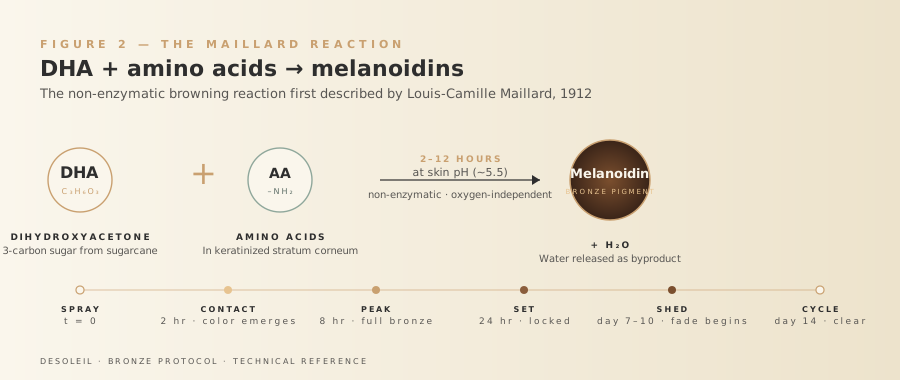
pH is one of the most underappreciated variables in sunless tanning. The Maillard reaction is pH-sensitive — it proceeds most efficiently in a slightly acidic environment (pH 4.5–5.5), which is also the natural pH of healthy skin. Stray from that range and the color shifts: higher pH pushes toward orange and yellow; lower pH slows development. This is why alkaline soaps, baking-soda scrubs, and anything that disrupts the skin's acid mantle are best avoided before and during the life of the tan — and why the first rinse is warm water only.
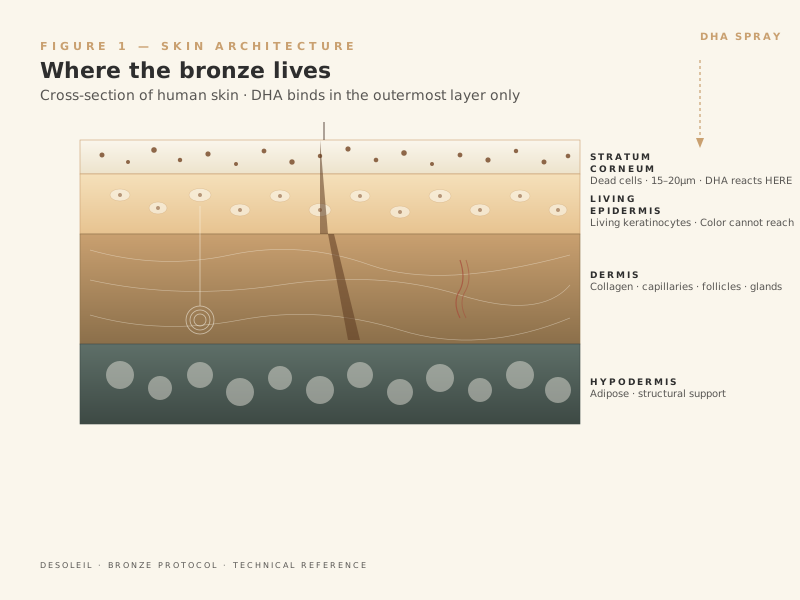
Before the formula, before the technique, there is your skin. It is worth pausing here, because skin is not a passive surface. It is an organ — alive, dynamic, deeply individual — changing daily in response to sleep, diet, stress, climate, hormones, and the history of everything applied to it. To understand a bronze is, first, to understand what it works with.
The stratum corneum is not uniform. It is thicker on the palms and soles where friction demands protection, thinner on the face, inner arms, and décolleté. Those variations directly shape how DHA reacts.
The most common misconception is that preparation begins forty-eight hours before the appointment. The full epidermal turnover cycle takes roughly 28 days — that month of cellular history is your canvas. You do not improve it by exfoliating twice the night before.
Three to four weeks before an important appointment, the work begins as attention, not effort: consistent daily moisturizing, regular moderate exfoliation, and kindness to the skin barrier. The questions worth asking — is your skin consistently hydrated? Are you exfoliating at a rhythm that supports smooth turnover, rather than swinging between neglect and overcorrection?
A luminous glow is not conjured from a spray gun alone. It is built on skin prepared to receive it. The DHA reaction is a chemistry event, and chemistry responds to the conditions of its environment. The steps below are those conditions — and they're easy ones to keep.
Clothing is the last thing most people consider, and one of the first that decides whether the bronze survives its first hours. Tight waistbands, bra straps, and elastic pressing into fresh solution will mark it before it dries.
The studio uses Infinity Sun Rapid Development solutions, built on a proprietary acceleration technology — a blend of amino acids and mild catalysts that trigger the Maillard reaction at an accelerated rate. Rinse too early and you under-deliver; too late and you over-process. The window below is calibrated to your result. We set yours with you at the door.
The hours before your rinse are when your bronze is most vulnerable. The Maillard reaction is still completing its bond with the amino acids in your stratum corneum. Anything that introduces moisture, friction, or heat before it finishes will disrupt the architecture of your result.
The difference between a bronze that photographs beautifully and one that reads flat in evening light is often nothing more than timing. A tan at peak development — 24 to 48 hours post-rinse — is richer, more dimensional, and far more flattering on camera than one applied the night before. These windows have been refined over eighteen years of daily practice.
Not all solutions are equal, and the differences aren't mainly about DHA percentage. A professional formula is a layered architecture — a tanning system, a bronzing system, a hydration system, a skin-support system, and a stability system. Knowing what you're looking at is how you judge quality.
The Fitzpatrick Scale is the dermatological standard for classifying how skin responds to UV. In sunless tanning it's also the primary framework for predicting how DHA will react — how deep the color develops, how it reads against your undertone, and how long it lasts. Knowing where you fall is fundamental to setting expectations and choosing the right formula.
Fitzpatrick type tells you how much color you'll develop. Undertone tells you which direction it reads. A formula that's beautiful on a Type III with a cool-pink undertone can look muddy on a Type III with a yellow-olive one — at the exact same DHA concentration.
Orange comes from three causes, not one — and understanding each lets you prevent or correct it specifically.
Eighteen years of refinement.
Every variable accounted for.
The color in your stratum corneum is not a coating — it is a chemical bond. Architecture, not approximation. Treat it with care, and it will keep.