i.
Expert application
Hand-guided by Jana — eighteen years of practice on every contour. You are her only client for the hour.
A private studio in Santa Cruz where one expert hands you the bronze your skin would choose if it could speak. Eighteen years. One appointment at a time. The formula meets you where you are.
Four standards we hold to every appointment — the ones you notice the morning after.
Hand-guided by Jana — eighteen years of practice on every contour. You are her only client for the hour.
Your formula is matched to your undertone, your comfort, and the rhythm of the days around your appointment.
Skin-loving actives layered in alongside the bronze — niacinamide, hyaluronic acid, walnut and aloe. Hydration first.
One client. One suite. One quiet hour. Yours, in full.
Each one is chosen with you — your undertone, your timing, your comfort, the moment you're tanning for. We walk through it together at the door.
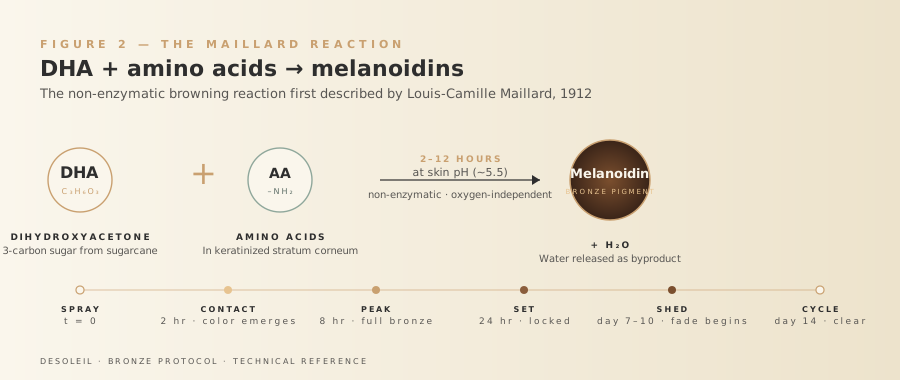
For the week when your calendar will not pause. A weightless veil that develops in two to five hours and is richest the morning after.
Niacinamide, hyaluronic acid, and a peptide complex are layered in alongside the bronze. The finish reads like your own skin — in daylight, in candlelight, in any lens.
Stage-level depth, hand-calibrated in two passes and supervised through development. Reserved for returning clients who book Ultra by name.
A botanical formula built on walnut extract and aloe barbadensis. Gentle, slow to develop, kind to sensitive skin. The bride's favorite.
Two of our six formulas are matched in conversation — not a menu. If your skin or occasion calls for something specific, we'll talk it through at the door.
Reach out and tell us about the occasion. We'll suggest the right one for your skin, your timing, and the way the light will fall.
Your skin is the canvas — and yours is unlike anyone else's. A bride, a man in training, mature skin, an athlete in season — each has its own preparation, formula, and ease.
Trial. Bachelorette. The day. Honeymoon.
Bridal Protocol
Hair, shave, sweat — built into the formula.
Men's Protocol
Hydration-first. Pat, never rub. Pure ease.
Mature Protocol
Training, sweat, chlorine — scheduled around.
Athletes Protocol
Jana began studying sunless tanning in 2002 and opened deSoleil in 2007. Eighteen years later, she remains the only set of hands that touches a deSoleil session. The conversation comes first, the formula second, the color last. Always in that order.
Precision is the luxury. Eighteen years. One client at a time. Zero compromise.
A small selection from eighteen years of work — read each one through, the details say what we cannot.
Twenty minutes of conversation before anything began. She matched my undertone in a way nothing off a shelf ever has. My wedding photographer said the bronze "read as her own skin" — and I think that's the whole compliment.
I've had spray tans in three cities. None included a long conversation about the chlorine in my pool and how to keep it from striping my back. The care here is on a different floor. She's a craftsperson.
I'm fifty-four. My skin asks for kindness. Unity NR with the mature protocol gave me a four-day finish that felt like my own complexion — no streak, no mask. The aftercare alone was worth the appointment.
Tell us about the occasion — a wedding, a trip, an anniversary, a Tuesday. Jana reads every note herself and replies within a business day.