The Reference · Eighteen Years, Written Down

The Bronze Protocol.

Everything behind your glow, published in full. The chemistry of color, the way your skin receives it, how to prepare, when to rinse, and how to keep it beautifully for two weeks. Nothing here is guesswork — and now, none of it is secret.

Active
DHA · the Maillard reaction
Result
Color bonded in the skin's surface
Lifespan
10–14 days with care
Part One

The Science of Bronze

DHA, the Maillard reaction, and why your skin is the formula

You have met the Maillard reaction before. It is the browning of a bread crust, the caramel edge of a roasted onion, the sear on a steak — a cascade of molecular rearrangements that produces hundreds of new, richly colored compounds. That the very same chemistry gives you a bronze is not a coincidence. It is an elegant piece of molecular logic, and it is happening on the surface of your skin.
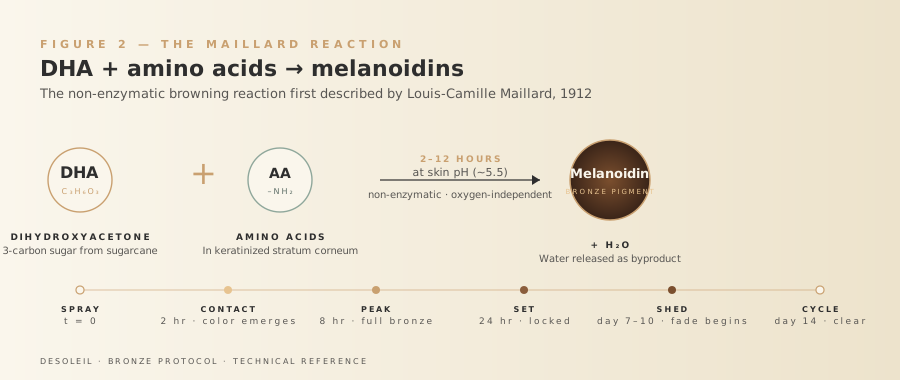
DHA does not tan the skin. It does not stimulate melanin or touch living tissue. What it does is far more precise — it colors the cells that have already done their living.
Diagram: DHA combines with amino acids to form melanoidin bronze pigment over 2 to 12 hours
Figure 2 — The Maillard reaction · DHA + amino acids → melanoidins
Chemistry · The Maillard Reaction Explained
How DHA creates color in the stratum corneum
Dihydroxyacetone (DHA) is a small three-carbon sugar — a ketotriose — derived from plant sources like sugar cane, sugar beet, or corn. It is water-soluble, colorless in solution, and chemically unremarkable until it touches skin.

At the surface of the stratum corneum, DHA finds an environment rich in free amino acids. Lysine and arginine are especially reactive. DHA's carbonyl group joins their free amino groups in a condensation reaction, forming an unstable Schiff base. That intermediate rapidly undergoes the Amadori rearrangement, and the resulting products fragment, recombine, and cross-link with neighboring amino groups.

The endpoint is a family of high-molecular-weight polymers called melanoidins — the pigments of a bronze. They are chemically bonded into the protein structure of the corneocyte. They are not coatings, not surface dyes; they have become part of the architecture of your skin's surface.

The color is not on the skin. It is in it. It sheds naturally as the stratum corneum renews — typically over 10–14 days — which is why hydration, gentle cleansing, and avoiding abrasion extend your result.
3
Carbon atoms in DHA
2–4 hr
To initial color
24 hr
To full color peak
10–14 d
Life with proper care
0
UV radiation required

The role of pH

pH is one of the most underappreciated variables in sunless tanning. The Maillard reaction is pH-sensitive — it proceeds most efficiently in a slightly acidic environment (pH 4.5–5.5), which is also the natural pH of healthy skin. Stray from that range and the color shifts: higher pH pushes toward orange and yellow; lower pH slows development. This is why alkaline soaps, baking-soda scrubs, and anything that disrupts the skin's acid mantle are best avoided before and during the life of the tan — and why the first rinse is warm water only.
Chemistry · Erythrulose
The secondary tanning agent
Many professional formulas include erythrulose, a four-carbon ketose sugar derived from raspberries. It reacts more slowly than DHA — developing over 24–48 hours — and produces a slightly redder-brown undertone. Combined with DHA, it softens initial development, smooths the fade, and reduces streaking. Its presence is generally a marker of technical sophistication: DHA builds depth quickly; erythrulose refines and extends it.
Part Two

Your Skin Architecture

The living canvas — why your skin biology determines everything

Before the formula, before the technique, there is your skin. It is worth pausing here, because skin is not a passive surface. It is an organ — alive, dynamic, deeply individual — changing daily in response to sleep, diet, stress, climate, hormones, and the history of everything applied to it. To understand a bronze is, first, to understand what it works with.

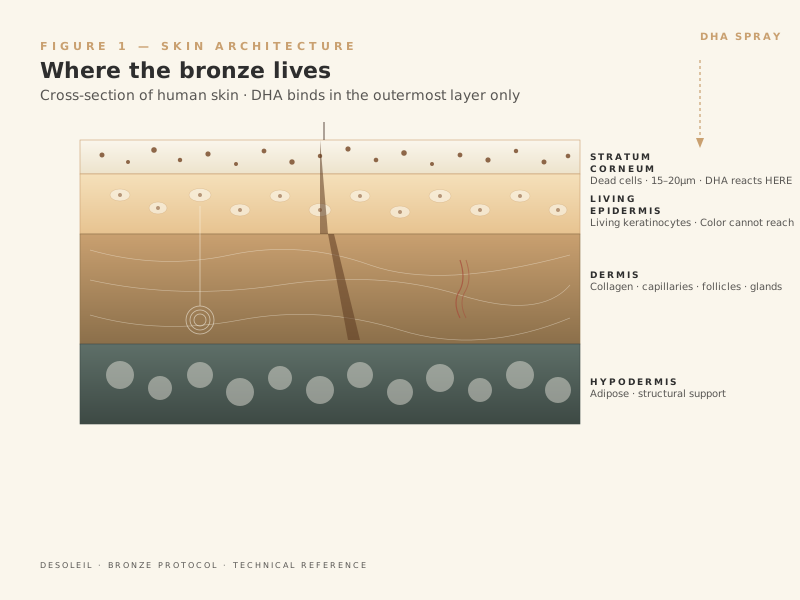
Cross-section diagram of human skin showing the stratum corneum where DHA binds, above the living epidermis, dermis, and hypodermis
Figure 1 — Skin architecture · the bronze lives in the outermost layer only
Biology · The Epidermal Architecture
The stratum corneum: where everything happens
The epidermis is the outermost layer of skin, built of several distinct strata. At its deepest, the stratum basale generates new keratinocytes through continuous cell division. These cells migrate upward over roughly 28 days, flattening and losing their nuclei through keratinization — a transformation that makes them hard, durable, and impermeable.

By the time they reach the surface, they are corneocytes: dead, flattened cells arranged like overlapping roof tiles. Together they form the stratum corneum — the only layer a bronze formula will ever touch.

The stratum corneum is 15–20 cell layers thick, thinner than a sheet of paper. In that paper-thin surface lives every variable that determines the quality of your color.

Why problem areas exist

The stratum corneum is not uniform. It is thicker on the palms and soles where friction demands protection, thinner on the face, inner arms, and décolleté. Those variations directly shape how DHA reacts.

Elbows · Knees · Ankles
Thick stratum corneum
More corneocytes, more amino-acid sites. Absorbs more formula, develops darker, fades faster. Asks for extra exfoliation and a touch of barrier before every appointment.
Face · Inner Arms · Décolleté
Thin stratum corneum
Fewer amino-acid layers. Receives formula more delicately, tends toward a lighter, more luminous result. Sensitive to pH disruption and harsh products.
Hands & Feet
High friction, high shedding
Constant use speeds shedding, so these areas fade first. A light hand during application, and a home touch-up mousse keeps them even between sessions.

The 28-day skin cycle

The most common misconception is that preparation begins forty-eight hours before the appointment. The full epidermal turnover cycle takes roughly 28 days — that month of cellular history is your canvas. You do not improve it by exfoliating twice the night before.

You cannot fix a month of neglect in forty-eight hours. But you can undo a month of good preparation in forty-eight. That asymmetry is worth knowing.

Three to four weeks before an important appointment, the work begins as attention, not effort: consistent daily moisturizing, regular moderate exfoliation, and kindness to the skin barrier. The questions worth asking — is your skin consistently hydrated? Are you exfoliating at a rhythm that supports smooth turnover, rather than swinging between neglect and overcorrection?

Good to Know · Retinoids & Active Acids
Pause aggressive actives 7–10 days before
Retinoids (over-the-counter retinol and prescription tretinoin) and strong exfoliating acids (glycolic, salicylic, lactic) accelerate epidermal turnover. Heavily treated areas absorb DHA differently than untreated ones, which can leave a mottled result no technique fully corrects. Pause retinoids on the body 7–10 days before a key tan, and on the face 5–7 days. Resume once your bronze has fully developed and settled.
Part Three

Preparing the Canvas

The foundation every beautiful bronze is built on

A luminous glow is not conjured from a spray gun alone. It is built on skin prepared to receive it. The DHA reaction is a chemistry event, and chemistry responds to the conditions of its environment. The steps below are those conditions — and they're easy ones to keep.

Skin Science · Why Preparation Changes Everything
Exfoliation, pH balance & the architecture of a precise result
DHA reacts with the amino acids — primarily histidine, lysine, and arginine — in the dead-cell layer of the stratum corneum. When that layer is uneven, oily, or loaded with product residue, the reaction fires inconsistently. Exfoliation removes the uneven cells; pH balance lets the surface accept DHA uniformly. The result isn't just a deeper bronze — it's a more even one that holds its shape as it fades.
The Professional Foundation
Infinity Sun Exfoliating Body Masque
Bromelain (pineapple enzyme) + kaolin clay + fine jojoba beads. A biochemical resurfacing that dissolves dead cells rather than only scrubbing them, and rinses residue-free for maximum, even DHA grab. Microplastic-free. Available in-studio and at desoleiltan.com/shop.

48–72 hours before your appointment
Finish waxing & laser hair removal. Open follicles absorb solution unevenly, leaving a dotted look. Minimum 48 hours ahead; 72 is better.
Schedule manicures, pedicures, and facials before your tan. Any service with soaking, exfoliating tools, or heat should happen first — water and abrasion lift fresh color.
Avoid prolonged sun. Shedding or sunburned skin develops and fades unevenly, whatever the solution.
Begin a twice-daily moisturizer. A water-based lotion, not a straight oil. Start 2–3 days ahead to build hydration into the stratum corneum.
Remove existing self-tanner. Use a dedicated remover 24–48 hours prior, or ask for an in-studio prep add-on. Book at desoleiltan.com/book.

24–48 hours before · exfoliation
Full-body exfoliation in the shower. Use exfoliating gloves, a physical scrub, or an enzymatic masque. Focus on elbows, knees, ankles, wrists, and décolleté — the high-absorption zones that take the most and fade the fastest.
Can I exfoliate the morning of my appointment?
Exfoliate the day before, not the morning of. Exfoliating right before arriving can mildly sensitize skin and briefly raise surface pH — both causing uneven absorption. The 24–48 hour window lets the acid mantle re-establish so the reaction fires at its ideal pH.
Shave a few hours prior, not right before. Freshly shaved skin absorbs solution differently at the follicle. Shaving opens it; a few hours lets it settle. For waxing, allow 48 hours.

Day of · products & conditions
No moisturizer on appointment day. Even a light formula creates a barrier that blocks DHA and causes surface patchiness, especially on arms and legs.
What about dry areas like elbows and knees?
Especially not there. Elbows, knees, and ankles are high-absorption zones where moisturizer causes patchy pooling. Extra exfoliation the day before is the right preparation — not product on the day.
No deodorant or antiperspirant. Aluminum-based formulas block absorption and react with DHA to produce a green or ashy tint underarm. If you've applied some, wipe the area with a damp cloth and pat fully dry before your session.
What if I forgot and already applied deodorant?
Wipe the underarm thoroughly with a damp cloth and let it air-dry completely — at least 10–15 minutes. A dry makeup wipe works too. Done right before application, it won't ruin your result. Skip soap and heavy cleansers, which shift surface pH.
No perfume, cologne, or body spray. Fragrance compounds react with DHA and cause uneven development, most visibly on the neck and chest.
No coconut oil, body oil, or oil-based products. Pure oils form a barrier against DHA and dissolve the Maillard bond. This one holds for the entire life of your bronze.
What about oil-based makeup or serums on my face?
Skip oil-based primers, facial oils, and oil-heavy serums on the day. Water-based or gel formulas are fine. For the face especially, keep it product-free before application — facial tanning needs the cleanest possible surface for even color.
Part Three · Continued

What to Wear

To your appointment, and for the rest of the day

Clothing is the last thing most people consider, and one of the first that decides whether the bronze survives its first hours. Tight waistbands, bra straps, and elastic pressing into fresh solution will mark it before it dries.

✓ Wear to your appointment
Loose dark pants or a maxi skirt
Relaxed top or oversized tee
Slip-on sandals or loose flats
Soft dark underwear, no elastic waistbands
A zip-up hoodie, not a pullover
✗ Save for after rinse
Tight jeans or athletic leggings
Underwire or padded bras
Knee-high socks or compression wear
Structured waistbands or cinched belts
Light-colored synthetic fabrics
✓ Accessories
Hair fully off neck and ears before application
All jewelry removed before you arrive
A dark towel for your first evening
A neckline reference if matching for an event
✓ For sleeping
Dark, loose-fitting sleepwear
Dark bed sheets — bronzer transfers, it washes out
No tight socks or waistbands overnight
A little finishing powder on friction zones
The cosmetic bronzer in your solution transfers to light and synthetic fabrics during the first hours — and it washes out completely. It is guide color, not permanent staining. The actual color is bonding in the stratum corneum and cannot be washed away. Darker clothing simply protects your developing bronze and your wardrobe at once.
Immediate Post-Application Comfort
Dolce Dust Finishing Powder
A professional, talc-free setting powder used in the studio. It lifts the post-tan sticky feeling, minimizes transfer onto clothing and linens, and protects friction zones — inner elbows, underarms, behind the knees — through your pre-rinse window. Coconut Cream scent, in shimmer or matte. Talc-free · hypoallergenic · vegan · cruelty-free. Available in-studio and at desoleiltan.com/shop.
Part Four

The Development Window

When to rinse — your single most important decision

The studio uses Infinity Sun Rapid Development solutions, built on a proprietary acceleration technology — a blend of amino acids and mild catalysts that trigger the Maillard reaction at an accelerated rate. Rinse too early and you under-deliver; too late and you over-process. The window below is calibrated to your result. We set yours with you at the door.

2 hr
Light
Natural warmth, a luminous glow
3–4 hr
Medium
Golden, dimensional bronze
4–5 hr
Deep
Rich, saturated depth
8–12 hr
Ultra Dark
Specific formulas only, by invitation
← LighterDeeper →

The first rinse · step by step
Warm water only, never hot. Hot water opens pores and disrupts the developing DHA bond. Warm water clears the guide bronzer while the reaction continues undisturbed.
No soap on the first rinse. Water only — rinse until it runs clear. Your bronze is already bonded in the stratum corneum and cannot be washed away.
Why no soap on the first rinse?
The guide bronzer is cosmetic color that rinses with warm water alone. Soap is typically alkaline, and using it on a developing tan shifts surface pH and strips developing DHA before bonding is complete. Water only on the first rinse — you can use pHydra-Luxe Body Wash from your second shower onward.
Pat dry immediately, never rub. Towel friction disturbs the surface bond while the reaction is still completing. Pat gently from the moment you step out.
The rinse runs golden-brown — exactly right. That's the cosmetic guide coat leaving. Your dimensional bronze reveals itself over the next 24 hours.
First time? Always rinse at the shorter end of your target window. Solution keeps developing slightly after rinsing, so a lighter first result is simply calibration data — you can always go deeper next time. You cannot go lighter from an overdeveloped base.
Part Four · Continued

The Preservation Protocol

Protecting your bronze — the critical first window, and the full 14 days

The hours before your rinse are when your bronze is most vulnerable. The Maillard reaction is still completing its bond with the amino acids in your stratum corneum. Anything that introduces moisture, friction, or heat before it finishes will disrupt the architecture of your result.

Before your rinse · the protected window
No water of any kind. No showers, baths, ocean, pool, rain, or sprinklers. Even running water over a wrist wicks upward across developing color.
No exercise or perspiration. Sweat introduces salt and moisture that streak and lighten developing bronze. Plan workouts around the window.
No tight clothing. Elastic, waistbands, and bra straps press into developing bronze and leave pale lines. Stay in your loose arrival clothes.
No product application. No deodorant, lotion, or perfume until after your first rinse.
Avoid rain, steam, sauna, and direct heat. Heated seats, heavy humidity, saunas, and steam rooms introduce moisture before the bond completes — and heat also speeds the reaction itself, pushing development deeper and less evenly than intended. Stay cool until your tan is set.
Sleep on dark sheets. The cosmetic bronzer transfers to light linens the first night, and washes out completely.
Skin Science · Why Straight Oils Lift a Bronze
The oil rule — for the entire life of your tan
Pure oils — coconut, mineral, baby oil, petroleum jelly, and anything with oils high on the ingredient list — act as solvents against the DHA bond in the stratum corneum. They penetrate the upper layer and dissolve the color complexes formed by the Maillard reaction. This is not metaphor — the oil physically unbinds the melanoidins.

The rule holds from application through your tan's final day.

Regular lotions and body creams that list some oil but are water-first are safe — concentration and delivery matter. Oils inside cleansers behave differently and don't dissolve DHA. The line is simply: no straight (100%) oils used as a body moisturizer.

Day 1 through week two · the daily ritual
Moisturize twice daily with a lotion or hydrating cream — after every shower and before bed. Hydration is the single biggest factor in longevity; dry skin sheds faster.
What counts as a "straight oil"?
Pure 100% oils used as moisturizers: coconut, argan, baby, mineral, or olive oil — or any product where an oil is the primary ingredient. Water-based lotions and body creams, even those containing some oil, are safe. If the first ingredient is water, it's a lotion. If the first ingredient is an oil, avoid it.
Use pHydra-Luxe Body Wash for all showers. A pH-balanced, DHA-safe cleanser that cleans without stripping the moisture barrier or disrupting color. Sulfate-free · vegan · cruelty-free. At desoleiltan.com/shop.
Keep showers lukewarm and brief. Hot water is the fastest way to fade a bronze. Shorter, cooler showers add days.
Pat dry after every shower, never rub. Towel friction abrades the bond at the surface. Make the habit on day one and keep it for the life of the tan.
No coconut oil, body oils, mineral oil, or petroleum products for the life of your tan — these dissolve the color complex. Check every label.
No chlorine for 48 hours. After that, always rinse immediately and moisturize within 10 minutes of leaving the pool or ocean. Santa Cruz salt water — Pleasure Point, Capitola, Rio del Mar — follows the same rule: rinse and moisturize right after every session.
Why 48 hours specifically for chlorine?
The DHA bond reaches full depth roughly 24 hours post-rinse; the extra 24 lets the surface settle so chlorine has less to penetrate. After 48 hours, a pre-swim barrier of hydrating serum or lotion extends color life significantly. After ocean or pool, rinse with fresh water and moisturize within 10 minutes.
Wear a moisturizing, waterproof sunscreen in the sun. Your bronze gives zero UV protection — none. It is a cosmetic color change, not an SPF.
Drink plenty of water. Systemic dehydration speeds skin turnover. What you take in directly affects how long your color lasts.
Daily Body Wash · Days 1–14
pHydra-Luxe Body Wash
A pH-balanced, DHA-safe wash that cleanses without stripping the moisture barrier or disrupting color. Use from your first rinse through the life of your tan. DHA-safe · sulfate-free · vegan · cruelty-free. At desoleiltan.com/shop.
Daily Hydration · Days 1–14
Extend Hydrating Serum
A lightweight, fast-absorbing serum with hyaluronic acid, vitamins, and botanical actives — plus a low maintenance dose of DHA to refresh color daily. Maintains hydration, evens the fade, and can extend a 7-day result to 10–14. At desoleiltan.com/shop.
Part Five

Post-Bronze Security

Protecting your result when life doesn't pause — water, weather, and the unexpected
Salt water, beach days & pools
Salt water and chlorine both speed fading — but neither has to ruin a well-kept bronze. The protocol below protects your color before and after every ocean, pool, or coastal day, once your 48-hour post-appointment window has passed.
Before ocean or pool
Apply a generous layer of moisturizer or hydrating serum to all bronzed areas — the moisture barrier slows salt and chlorine. Then waterproof sunscreen over the top.
After ocean or pool
Rinse with fresh, cool water immediately. Pat fully dry, never rub. Moisturize within 10 minutes — this single step extends color dramatically. Glow on the Go Mousse restores depth to any areas lightened by salt or chlorine.
Chlorine pools
Wait 48 hours post-appointment before any pool. After that, always rinse immediately and moisturize within 10 minutes. Avoid long submersion — 20 minutes in chlorinated water fades more than a full day on land.
Ocean & salt water
Salt accelerates shedding through osmosis. After any ocean session, rinse, pat dry, and moisturize immediately, then again before bed.
Rain during the development window
01
Check the forecast before your appointment. If rain is likely within four hours, plan covered transport directly home.
02
Full-coverage loose clothing beats an umbrella — fabric physically shields developing solution from droplets.
03
If caught out: do not wipe or dab. Get indoors, air-dry fully, then continue your window. Rubbing streaks; air-drying does not.
04
Isolated droplet spots can often be softened with a dry blending brush once fully dry. Never wet the area to fix it — that enlarges the spot.
When something goes sideways
01
Do nothing first. The common "fixes" — scrubbing, more product, re-wetting — make it worse.
02
A warm rinse and 24 hours of patience resolves most concerns. Color keeps developing and settling for a full day after the first rinse.
03
For lingering patchiness: gentle enzymatic exfoliation (not scrubbing) plus a moisturizing extender evens the fade over 2–3 days.
04
If you tanned with deSoleil, text 831.479.8266 before doing anything — we keep formula notes on every session and can advise specifically.
When in doubt, do nothing. A warm rinse and a day of patience resolves most post-appointment concerns; intervention almost always makes it worse. Text us first.
Part Five · Continued

Timing Your Appointment

Booked to the occasion that matters

The difference between a bronze that photographs beautifully and one that reads flat in evening light is often nothing more than timing. A tan at peak development — 24 to 48 hours post-rinse — is richer, more dimensional, and far more flattering on camera than one applied the night before. These windows have been refined over eighteen years of daily practice.

Everyday events
1–2 days before
A fresh glow for weekend plans, a dinner, a casual shoot. Book 1–2 days prior for full development and a first rinse before you need it.
Formal events & galas
2–3 days before
Formal photography amplifies color. Two full days to develop and settle photographs more naturally and fades gracefully through the evening — no peaks, no patchiness.
Bridal trial
2–3 weeks before
A trial lets you see your exact result before it matters — calibrating solution, establishing your rinse window, and entering the wedding appointment with a tested formula.
Wedding day · final bronze
3 days before
Three days gives peak development, a complete first rinse, and a full 24-hour settle. Color is at its most refined and photograph-ready for the ceremony and reception.
Traveling? Book the day before departure so your bronze is freshly developed on arrival. Cabin air is extremely dehydrating — apply Extend Hydrating Serum before boarding, carry it on, and reapply on landing. Extra hydration in transit adds a day or two to your result.
For multi-person bookings, text 831.479.8266.
Part Six

The Formulas, Read

How to read a professional solution — and what to ask

Not all solutions are equal, and the differences aren't mainly about DHA percentage. A professional formula is a layered architecture — a tanning system, a bronzing system, a hydration system, a skin-support system, and a stability system. Knowing what you're looking at is how you judge quality.

Professional Formula Architecture
The five systems of a premium solution
1 · Tanning system — DHA percentage and quality (source, purity, particle size). Higher-quality DHA dissolves completely, distributes evenly, and colors predictably. Some formulas add erythrulose for a smoother, more fade-resistant result.

2 · Bronzing system — cosmetic bronzers give immediate visual color and preview the undertone. Walnut extract, caramel, and violet or green pigments preview and complement the DHA's final color — how a formula avoids orange or yellow.

3 · Hydration system — hyaluronic acid, glycerin, aloe, and other humectants that hold moisture during development, shaping how evenly DHA contacts the surface.

4 · Skin-support system — peptides, antioxidants (vitamins A, C & E), and botanical extracts that support skin health through the process.

5 · Stability system — pH buffers, preservatives, and film formers that hold the formula consistent, control development rate, and resist sweat.
Unity · Universal · All Skin Types
Advanced tonal-balancing technology — violet and brown pigments neutralize unwanted warmth across the full Fitzpatrick scale. Green-tea antioxidants, aloe barbadensis hydration, sweat-resistant. Vegan & cruelty-free. Rinse 2–4 hours. Best for: fair-to-medium skin, first-timers, pink or red undertones. Book →
Classic Bronze · Heritage · Deep Gold
Matrixyl 3000 peptide complex with vitamins A, C & E. Non-comedogenic, face and body safe. A deep-gold guide and the high-gloss Mediterranean finish that built the studio's name. Paraben-free, eco-certified DHA. Best for: medium-to-olive skin, returning clients. Book →
Bronze Organics · Botanical · Natural
Walnut-extract bronzer for a warm, earthy glow with no orange. Eco-certified DHA from sugar beet and cane, vitamins A, C & E in pure aloe barbadensis. Maximum hydration. Vegan · cruelty-free · paraben-free. Best for: sensitive skin, natural-formula clients, deep olive and darker tones. Book →
Ultra Dark · Depth · Mediterranean
Violet-base Mediterranean palette — beetroot and violet neutralize orange and yellow at high DHA. Hyaluronic-acid moisture magnet, structural peptides hold plumpness at maximum pigment. 8–24 hour window. Best for: experienced clients, deeper tones, an established base. Book →
Rapid Development · No Compromise
Proprietary acceleration technology — amino acids and catalysts trigger the reaction faster without compromising skin integrity. 2–5 hour window (shade-dependent), formulated without volatile organic compounds, on the same botanical base as Bronze Organics. Best for: time constraints, travel, event-day bookings. Book →
Perfectly Clear · Dye-Free · By Request
Perfectly Clear Spray Tan
Dye-free DHA delivers the full technical power of sunless tanning with zero cosmetic bronzer — no transfer on white silk, bed linens, or bridal gowns, and no visible guide color during development. The most hypoallergenic formula in the Infinity Sun line, and the one that most rewards eighteen years of practiced application. Best for: brides, sensitive skin, dye reactions. Ask at your consultation or reach out.
Clinical Add-On · Anti-Aging
A clinical enhancement layered over your bronze, targeting fine lines, texture, and laxity with professional-grade actives. Pairs with any base formula. Add to your service →
Clinical Add-On · Shimmer & Hydration
A luminizing, moisture-intensive layer applied post-tan — a dimensional glow with deep-hydration actives that extend color. Ideal for events, photo sessions, and weddings. Add to your service →
Your solution is chosen with you at your appointment — based on your Fitzpatrick type, your event timeline, and the depth you're after. Not sure which formula was used last time? Text 831.479.8266 — we keep detailed notes on every client's history.
Part Six · Continued

Skin Types, Undertones & Color Theory

How your tone shapes formula, development time, and result

The Fitzpatrick Scale is the dermatological standard for classifying how skin responds to UV. In sunless tanning it's also the primary framework for predicting how DHA will react — how deep the color develops, how it reads against your undertone, and how long it lasts. Knowing where you fall is fundamental to setting expectations and choosing the right formula.

Type I
Very Fair
Always burns, never tans. Often freckled, light eyes. DHA develops light-to-medium. Shorter rinse windows essential. Cool-toned violet formulas prevent orange.
Type II
Fair
Burns easily, tans minimally. Light-to-medium hair. DHA develops luminous and warm. The most forgiving type for first-timers — error is correctable.
Type III
Light-Medium
Burns moderately, tans gradually. The most common client type. Versatile formula range, natural results across most lines, medium rinse windows.
Type IV
Olive / Medium
Burns minimally, tans easily. Olive or yellow-leaning undertone. Warm-base formulas enhance naturally; watch green-toned bronzers against yellow.
Type V
Brown
Rarely burns, tans very easily. Rich warm undertones. DHA enhances rather than transforms. Organic walnut-base formulas shine — depth and luminosity over high DHA.
Type VI
Deep / Dark
Never burns. DHA gives a luminous, warming effect rather than a dramatic depth change. Sheer, hydration-forward formulas enhance glow without heaviness. Even application is paramount.

Undertone · the variable that picks the formula

Fitzpatrick type tells you how much color you'll develop. Undertone tells you which direction it reads. A formula that's beautiful on a Type III with a cool-pink undertone can look muddy on a Type III with a yellow-olive one — at the exact same DHA concentration.

Cool Undertone
Pink, rose, blue-veined
Best with violet-base or neutral bronzers. Avoid strong warm-gold, which can read orange against pink. The goal is a warm cool — a bronze that doesn't fight the skin's tone.
Neutral Undertone
Balanced, neither warm nor cool
The most versatile type. Works across most ranges and can lean warmer or cooler by formula. Neutral-toned rapid-development formulas give the most predictable result.
Warm Undertone
Yellow, gold, olive, peach
Best with walnut-base, warm organics, or caramel bronzers. Avoid green-base, which clashes with yellow. The goal is deepening existing warmth, not introducing conflict.

The truth about orange

Orange comes from three causes, not one — and understanding each lets you prevent or correct it specifically.

Wrong formula for the undertone. A warm-yellow bronzer against a pink undertone reads orange. Fix: a violet or neutral-base formula.
Over-processing — too long a window. At very high DHA or very long windows, the reaction pushes toward orange-brown melanoidins. Fix: rinse at the shorter end; build depth over visits.
pH disruption before or during development. Alkaline products beforehand, or soap on the first rinse, push toward yellow-orange. Fix: clean, product-free skin and warm water only on the first rinse.
Reference

The Protocol Checklist

Save this page. Check every box. Repeat.
28 days before · key appointments The Long Game
Consistent twice-daily moisturizing begun — no crash hydration the night before
Regular, not aggressive, exfoliation — 1–2× per week maximum
Retinoids and strong acids paused on the body; resume after the tan settles
Skin barrier intact — no prolonged sun damage or peeling
48–72 hrs before Pre-Preparation
Waxing or laser completed (48 hrs minimum)
Manicure, pedicure, facial scheduled before the tan
Sun exposure avoided — no sunburn, no active shedding
Twice-daily moisturizer continued
Existing self-tanner removed with a dedicated remover
24–48 hrs before Exfoliation Window
Full-body exfoliation — elbows, knees, ankles, décolleté
Shaving completed a few hours before, not right before
No exfoliation the morning of the appointment
Day of The Canvas
No moisturizer, deodorant, perfume, or product after showering
No coconut oil, body oil, or oil-based products
Loose dark clothing — no tight waistbands, underwire, or elastic
All jewelry removed before application
Rain forecast checked; covered transport planned if needed
Development window The Rinse
Light: rinse at 2 hours
Medium / golden: rinse at 3–4 hours
Deep: rinse at 4–5 hours
Ultra Dark (specific formulas): 8–12 hours
First rinse — warm water only, no soap, rinse until clear, pat dry
Before your rinse Protected Window
No water, sweat, or tight clothing until the window closes
Loose dark clothing only — no elastic, straps, or compression
Dark sheets for the first night
No product until after the first rinse
Dolce Dust on friction zones — inner elbows, underarms, behind knees
If caught in rain: indoors, air-dry, do not rub, continue the window
Days 1–14 Preservation
Moisturize twice daily — after every shower and before bed
Switch to pHydra-Luxe Body Wash — pH-balanced, DHA-safe, sulfate-free
Lukewarm showers only, kept brief — hot water fades fastest
Pat dry after every shower, never rub
No coconut oil, body oils, or petroleum products — life of the tan
No chlorine for 48 hours; after, rinse + moisturize within 10 minutes
After ocean / salt water: rinse, pat dry, moisturize within 10 minutes
Waterproof sunscreen before sun — bronze gives zero UV protection
Stay hydrated — water daily, the life of the tan
Timing reference Booking Calendar
Everyday: 1–2 days before
Formal event or gala: 2–3 days before
Bridal trial: 2–3 weeks before the date
Wedding day: final bronze 3 days before
Travel: day before departure; hydrate before & after the flight
Private · Appointment-Only · Santa Cruz · Est. 2007
deSoleil

Eighteen years of refinement.
Every variable accounted for.

The color in your stratum corneum is not a coating — it is a chemical bond. Architecture, not approximation. Treat it with care, and it will keep.